Categories
How to maintainance artificial sports turf

5 ways to maintain an artificial sports turf field

Tens of millions of artificial turf sports fields are constructed every year in the world. It is very important to prolong the service life of sports fields as much as possible through active and effective maintenance. Improper maintenance will seriously shorten the service life of artificial turf. According to the data obtained by the international professional sports field testing laboratory and FIFA, if the artificial turf field is not maintained enough or lacks maintenance, the increased wear, and tear of the product will lead to the early failure of the artificial turf field warranty, shorten the service life, and increase the number of sports activities. And many adverse consequences of the use of safety hazards.

Regarding the maintenance and maintenance of artificial turf fields, the following aspects can be carried out.
Basic requirements

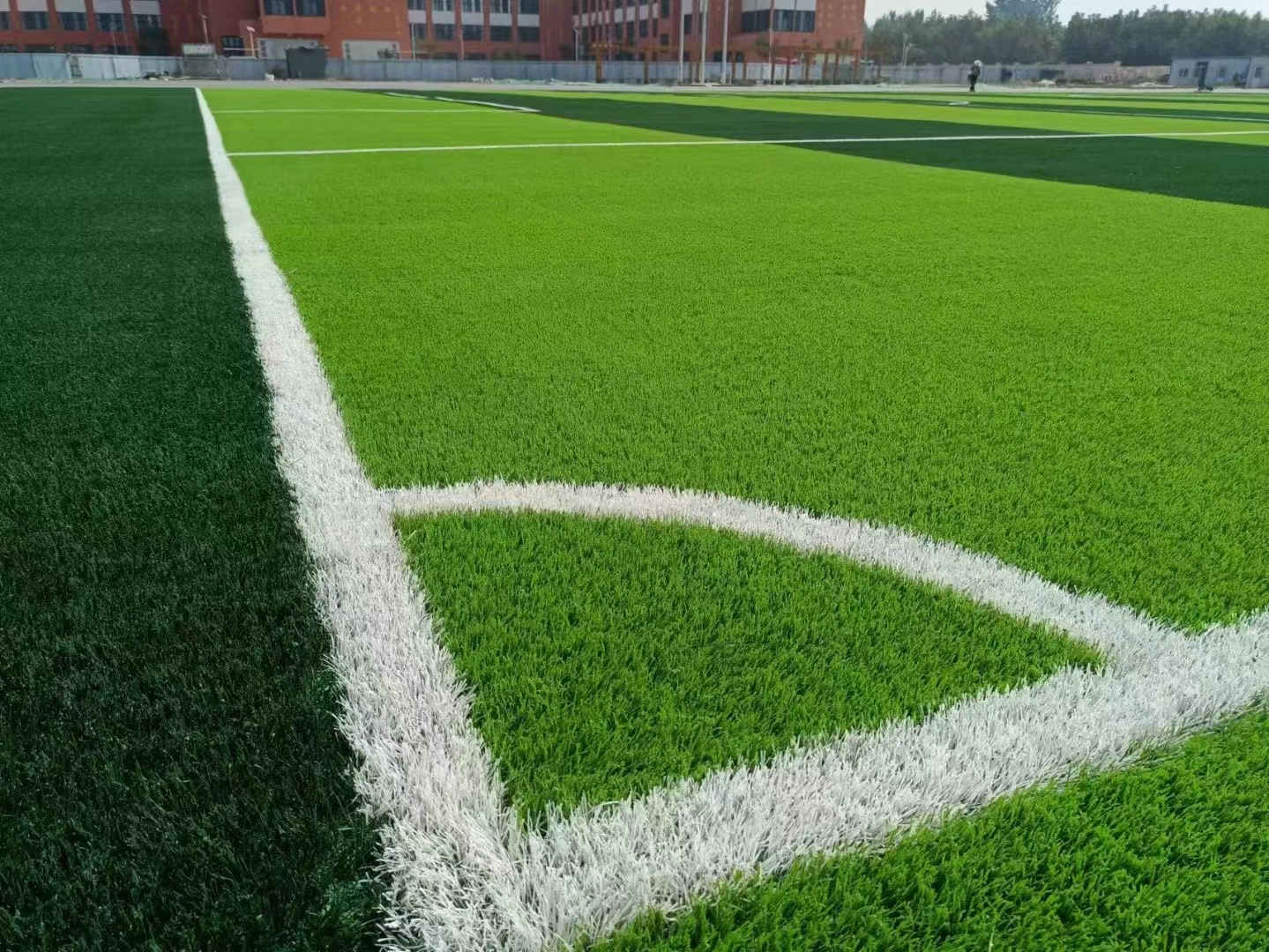
Try to keep the site as clean as possible, erect a “no smoking” sign around the grass, do not allow motor vehicles and heavy objects to enter the sports field, reduce the number of cleanings, avoid cleaning when the temperature is high, set up enough trash cans, control the use of the site, and find small Damage should be repaired in time.

Cleaning and maintenance

1. Use a vacuum cleaner to clean paper, fruit shells, and other debris in time after the game.

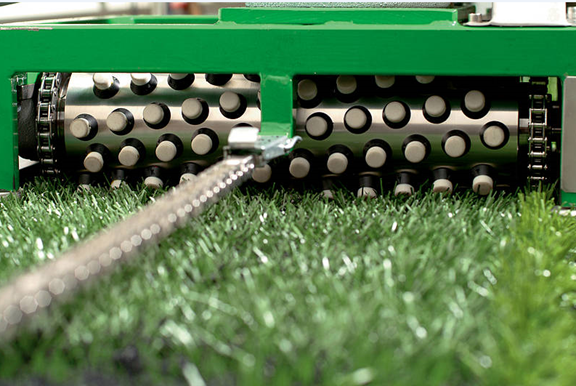
2. Comb the grass seedlings with a special brush every two weeks to remove the dirt and leaves on the lawn.

3. Use a special target to level the quartz sand and rubber particles once a month or after frequent games (football field).

4. When it is hot in summer, you can spray the lawn with water to cool down, so as to make the athletes cool and comfortable.

The removal of stains

1. “Water-like” stains such as juice, milk, ice cream, and blood stains: first scrub with soapy water, then rinse the place with soapy water for a long time with clean water; if necessary, dry it with a strong absorbent towel.

2. Oily stains such as shoe polish, sunscreen oil, ballpoint pen oil, etc.: can be wiped with a sponge dipped in perchloroethylene, and dried with a towel with strong adsorption; nail polish: can be wiped with acetone.

3. Paraffin, asphalt, and asphalt: Wipe vigorously or wipe with a sponge dipped in perchloroethylene.

4. Paints, coatings, etc.: Can be wiped off with turpentine or paint, and decontaminated with detergent and water. Rinse the cleaner with cold water and wipe vigorously, using a sponge dipped in perchloroacetic acid.

5. Chewing gum: spray freon into small pieces and then remove the residue.

Fill maintenance

1. The scouring and cleaning of heavy rain will cause a small amount of filler loss. The place to be filled can be sprinkled with quartz sand, and rubber granules, and completely swept into the turf (football field).

2. Carefully check whether the suture is loose and whether there is damage, tearing, burning, etc. at the bottom of the entire turf. If you find a large area of ​​repair, you should contact the paving company in time.

Prohibited items

1. Smoking, setting off fireworks, and welding in the venue.

2. Throwing chewing gum, fruit peel snacks, fruit juice drinks, and oil stains on the field.

3. Cars, motorcycles, and other vehicles and heavy objects enter the site.

4. Use inappropriate shoes or sports machineries such as spikes and javelins.

5. Use chemical cleaners, herbicides and pesticides.

The maintenance and upkeep of the artificial turf field are a must. Proper maintenance of the artificial turf field can not only effectively prolong the service life of the field and make it meet the warranty requirements of the lawn builder and lawn provider, but also maximize the life of the artificial turf field. Beautify the appearance of the venue, improve sports comfort, ensure the quality and safety of various sports in the venue and reduce venue management risks.
Categories
5 M width artificial grass

Are you looking for 5 M width artificial grass?

Are you looking for 5 M width artificial grass?

Mango Sports’ supply widths of artificial grass there are 2 meters, 3.75meters,4 meters, 4.57 meters, and 5 meters.
The length is generally 25M. If it is a sports artificial grass, its length can be specified according to the size of the site.

Mango Sports also supply DIY-size artificial grass, there are 1*1M, 1*2M, 1*3M, and 1*4M, suitable for online stores such as supermarket chains, Amazon, eBay, online, etc.

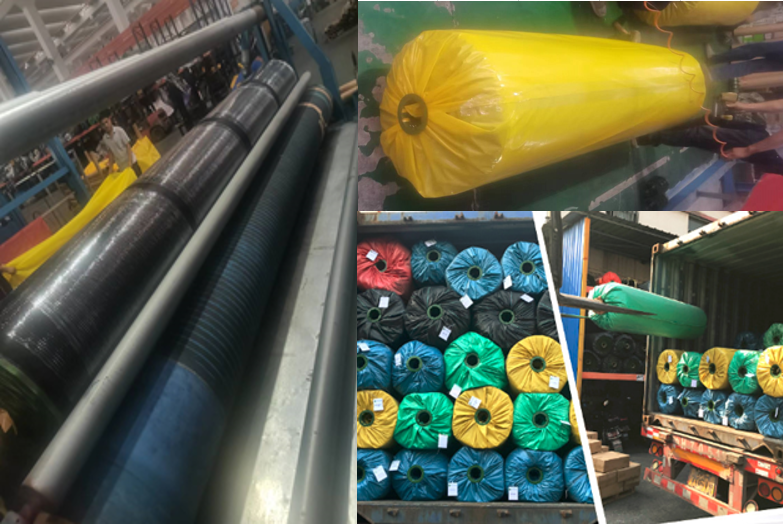
Different colors of packaging help customers identify models.

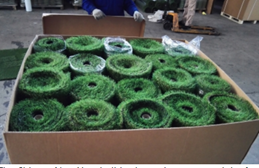
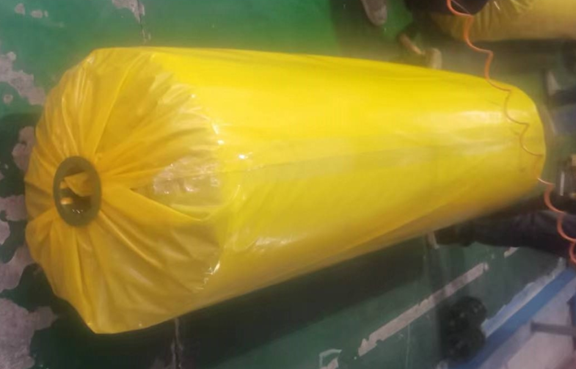
By the way, I will mention the packaging of artificial grass here. The artificial grass packaging used in the project is usually wrapped in PP bags after wrapping. The packaging of DIY artificial grass is mostly wrapped in film, with the customer’s LOGO or label attached, and then shipped by carton after packaging.

The roll width of traditional artificial grass is generally 4 meters. Now the introduction of 5 meters wide artificial grass is to better serve people who love artificial grass and adapt to the development of the market.
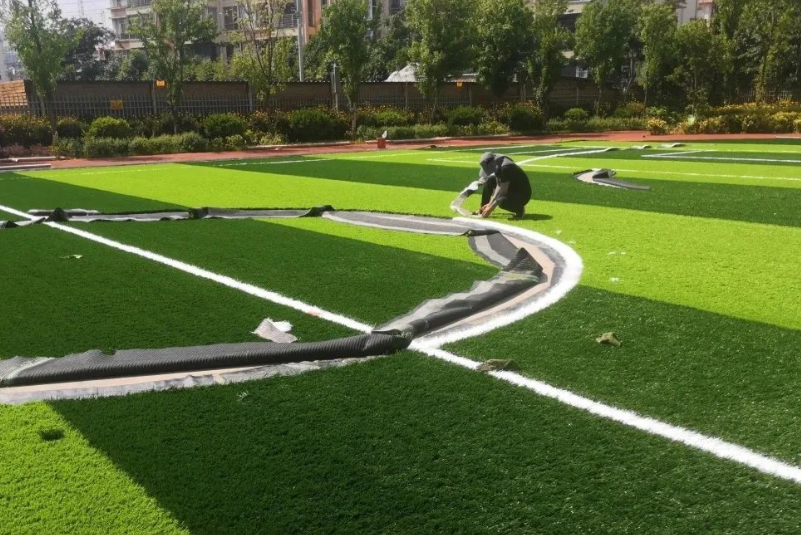
When installing artificial grass, artificial grass installers need seam tape to connect two pieces of artificial grass, so that there are gaps and marks on the surface.
5m wide artificial grass is very suitable for large gardens and places where a lot of space needs to be covered, usually, it does not need seams, it looks more natural and has a more perfect appearance.
In pursuit of perfection, find a local artificial grass installer near you to install 5m wide artificial grass and enjoy a seamless, perfect-looking artificial turf in your garden or outdoor space.
Whether you want to add some greenery to your garden or create a space for your kids to play, this is the ideal solution. Our 5M wide artificial turf needs no mowing, watering, or feeding and requires little maintenance.

Mango Sports is a leading supplier of 5m artificial grass in China Asia. We are proud to offer our customers incredible savings on prices and high-quality products and services.

Categories
Artificial grass installation

How to install an artificial football turf field?

Artificial football turf has become the first choice for most stadiums and training grounds. Compared to natural grass, artificial turf provides many benefits.

Benefits of Artificial Turf Fields

  • Low maintenance(e.g. How to maintain artificial turf ?)
  • All-weather usability
  • High durability
  • Cost-effective over time
  • Environmentally friendly (no need for pesticides or watering)

Steps to Install an Artificial Football Turf Field

1. Planning and Design

Before installing, consider the following:

  • Field dimensions (5-a-side, 7-a-side, 11-a-side, etc.)
  • Field layout and orientation
  • Drainage systems
  • Type of infill (sand, rubber, or both)
  • Fencing, lighting, and other infrastructure

2. Base Preparation

  • Remove existing vegetation and topsoil
  • Install drainage layers (gravel and geotextile)
  • Compact the base to ensure stability
  • Laser-grade the surface for a smooth and level foundation

3. Laying the Artificial Turf

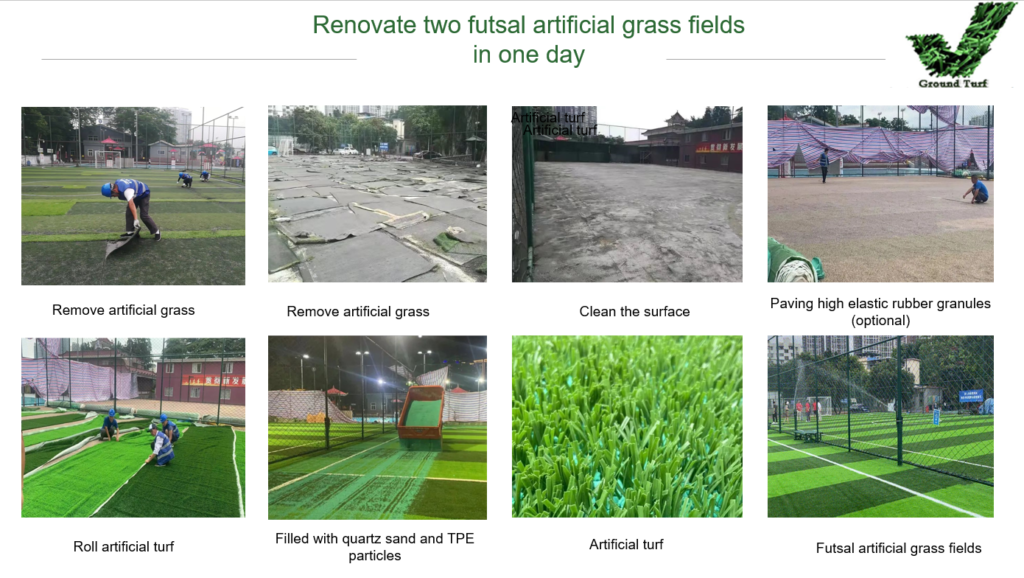
  • Roll out the turf according to field dimensions
  • Make sure all pieces face the same direction to maintain consistent appearance
  • Trim the edges as needed

4. Joining the Turf Rolls

  • Apply seam tape and adhesive to connect turf rolls
  • Ensure seams are tight and invisible
  • Let the adhesive cure before walking on the turf

5. Infill Application

  • Spread silica sand as the first infill layer
  • Add rubber granules on top of the sand for cushioning
  • Use a power brush to evenly distribute the infill materials
  • Repeat brushing to help fibers stand upright

6. Line Markings

  • Use white turf lines or paint for markings (center circle, penalty box, etc.)
  • Ensure all dimensions comply with FIFA or local standards

7. Final Inspection and Maintenance Plan

  • Inspect for wrinkles, seams, or inconsistent infill
  • Create a maintenance schedule: brushing, debris removal, and infill topping
  • Ensure proper drainage functionality after heavy rainfall

Common Questions (FAQ)

Q: How long does it take to install a football turf field?
A: Typically, 2–4 weeks depending on field size and weather conditions.

Q: What is the life expectancy of artificial turf?
A: 8 to 10 years with proper maintenance.

Q: Is artificial turf safe for players?
A: Yes. Modern turf systems offer good shock absorption and reduce injury risks.

Q: Can artificial turf be used in all weather conditions?
A: Absolutely. It performs well in rain, snow, and heat.

Q: how to choose the right synthetic turf for sports fields?
A: User Guide


Conclusion

Installing an artificial football turf field is a major investment that offers excellent returns in usability, maintenance savings, and player satisfaction. Follow each step carefully, or hire a professional team to ensure long-term performance and durability.


Categories
Artificial grass carpet near me

Get a quick look at the origin and development of artificial grass carpets

Although there are many artificial grass carpets near us, do you know the origin of artificial grass carpets?

The development of artificial grass has a history of more than 60 years. It first originated in the United States. At that time, because the natural grass under the roof could not grow, in order to solve this problem, artificial turf was developed. Since then, artificial turf has spread from the United States to the world, forming a market situation of American grass, European grass, Australian grass, and Asian grass, and American grass has stronger market competition due to its long history, advanced materials, and technology force. Artificial grass fields have great advantages and will undoubtedly be used more and more commonly.

In many countries in the world, due to the influence of factors such as different geographical locations, extreme natural conditions, and their respective economic conditions, and also because of the objective fact that a considerable number of natural grass fields must be equipped with roofs and other facilities, natural grass installation and maintenance becomes more difficult. It is under such specific conditions that synthetic grass shows its great advantages. After a long period of development, artificial grass technology has become relatively mature, and many technical indicators have been close to natural grass, which can meet the technical requirements of professional football games on the surface of the playing field.

In this context, in 2001, FIFA introduced the “FIFA Recommended” quality certification system. UEFA and many football associations responded immediately and arranged more and more international competitions to be held on artificial turf. On February 28, 2004, at the 118th annual meeting of the FIFA Council held in London, England, FIFA passed a resolution to allow the use of artificial turf in professional competitions. In August 2005, FIFA and UEFA unified the “testing and certification standards for football pitches” and launched a higher standard FIFA two-star standard test, agreeing that the World Cup finals can be played on artificial turf pitches that meet the above standards. held above

The recommendation and green light of artificial turf by various international football institutions and sports departments have provided favorable conditions for promoting the popularization and application of artificial turf in hot regions, alpine regions, and those countries and regions whose economic conditions are not suitable for planting natural grass.

With the development of the market, artificial grass has undergone great changes in materials, technology, construction, etc. The purpose of these changes is to make artificial grass closer to natural grass in terms of sports performance, which can be roughly divided into the following stages :

The first stage: The main material is nylon 6 (polycaprolactam), which is drawn and inserted into the base fabric. Carpet-like, poor elasticity; expensive.

The second stage: It is mainly made of polypropylene (pp) material, which is also extruded and drawn into the base cloth. After paving, it is filled with quartz sand particles. The hardness is high, but the price is cheap.

The third stage: It is mainly made of polyethylene (PE) material, which is also made of extruded wire and inserted into the base cloth. After paving, it is filled with quartz sand and rubber particles. It has the elasticity of natural grass and has great sports performance for improvement;

The fourth stage: Taking FIFA certification as the standard, focusing on the construction of system engineerings such as foundation and construction. In this stage, in addition to mesh products, there are also straight and curved products. The materials are pe and pp mixed, pe and nylon are mixed, and Sports performance is further enhanced.

The fifth stage: is mainly monofilament grass, in addition to the pursuit of sports performance, but also the pursuit of a more ideal appearance, while paying more attention to the construction of the system.

The sixth stage: mainly curly grass, sports, and leisure grass specially tailored for noble sports such as gate courts and golf.

Through the above content, you will have an understanding of the artificial grass carpet near you.

Categories
Football turf near me

What type of football field is near you and me?

In recent years, more and more competition venues, schools, and private clubs have built football artificial turf fields near football fans. Professional football field installers know that building a football field is not a simple matter. Site selection-design-decoration-approach-operation, every step is seemingly simple but not easy to do.

Of course, before considering these steps, you have to think about what type of football stadium are you going to build.

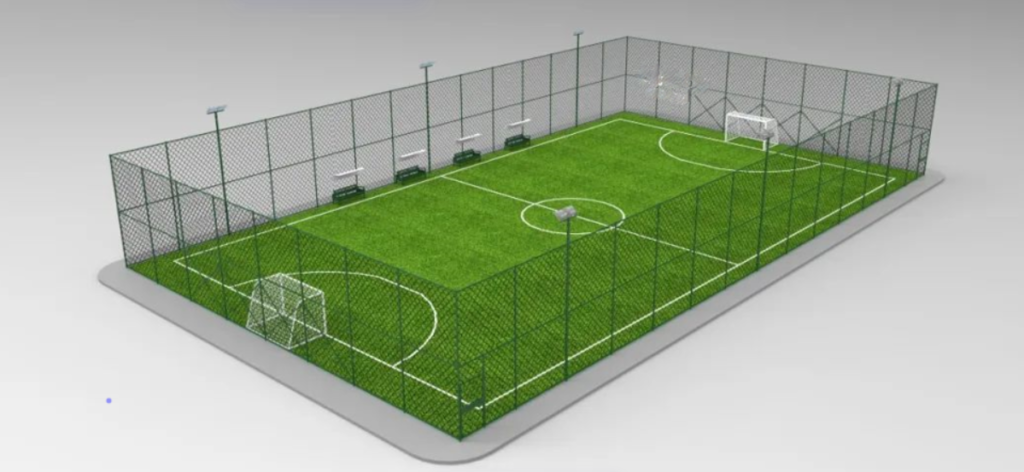
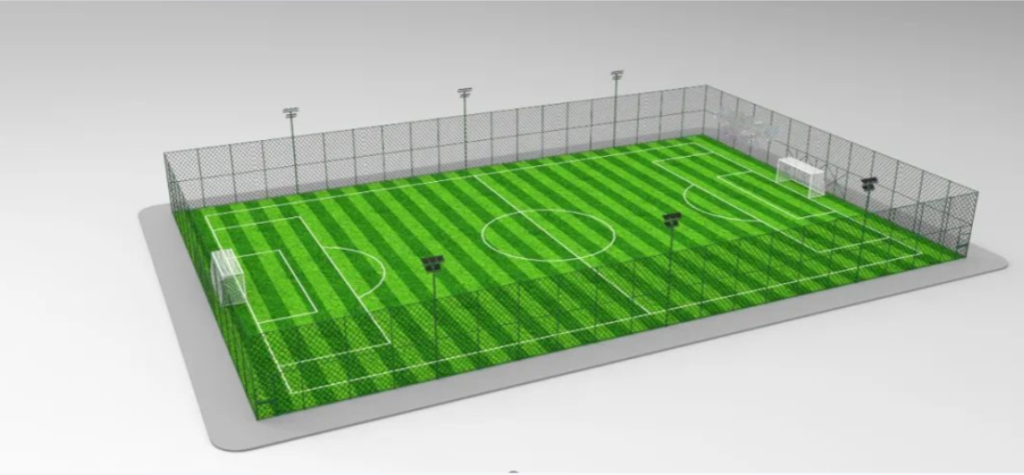
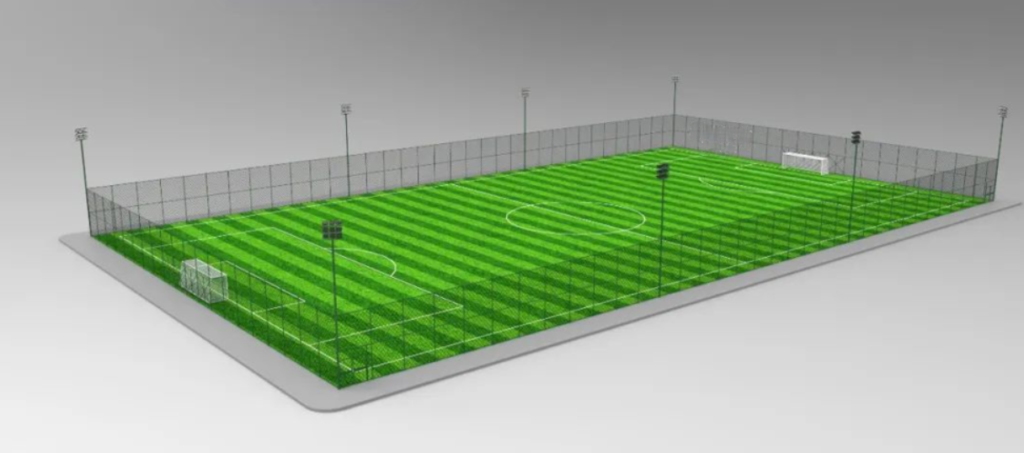
There are four common types of football pitches, three-a-side, five-a-side, seven-a-side, and eleven-a-side. Each type has different requirements for the standard area of ​​the site. Today we will take you to a brief introduction:

Three-player football field

Three-player football field: The length of the competition area is 20~35m, the width is 12~21m, and the total area is about 240~735㎡.

The three-person football field occupies a small area, and the area is generally 380 square meters (the area of ​​the field can be changed). Due to the size of the field space, small football does not require too many complicated movement steps. Due to the small number of people, the three-person system is different from international standard football, and there is no goalkeeper or offside substitute. At present, three-player football is rarely used in football stadiums, and most three-player sports venues are generally used in leisure places, such as business clubs, private clubs, or community venues. Most of the small sports venues have special venue size drawings according to customer needs.

 The three-person football field is paved with artificial turf. Artificial turf does not affect the running speed of the football but also protects the players. The artificial turf itself has a high density, and it is not suitable to use grass with a higher turf on the football field. The higher grass will affect the normal running speed of the football, and the higher turf will bring a heavy feeling to the soles of the players’ feet.

Futsal pitch

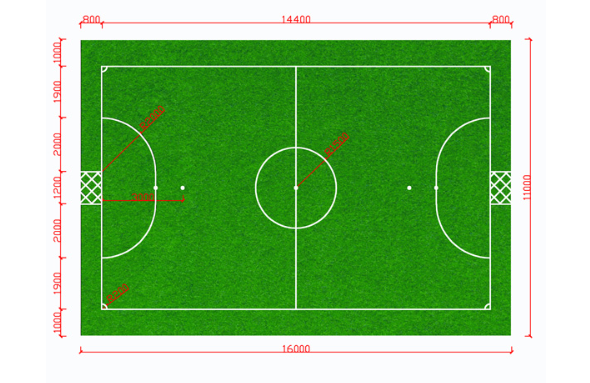
Futsal pitch: The playing area is 25~42m long and 15~25m wide. In any case, the length must exceed the width.

The length of the competition area of ​​the international competition venue is 38~42m, the width is 18~22m, and the line width of the venue shall not exceed 8cm.

Futsal matches are usually played indoors, with only five players per team playing instead of the usual 11. Unlike ordinary football fields, it has a smaller field and requires the use of smaller goals and smaller size footballs to shorten the playing time.

Most countries no longer treat futsal as an informal, unofficial mini-soccer. It has become one of the most popular sports in the world.

Seven-a-side football field

Seven-a-side football field: There is no international standard. The playing area is 50~70m long and 40~50m wide. It must be rectangular. Generally, there are many fields constructed according to the length of 65m and the width of 45m. There is at least a buffer zone of more than 2m on each side outside the competition line. The size of the field is 69m*49m=3381㎡.

Seven-a-side football field diagram Seven-a-side football is a variant of football and belongs to the amateur football competition system. In seven-a-side football, each team has only 7 players on the field, and the competition venue, game rules, tactics, etc. of seven-a-side football are different from ordinary football.

Eleven football field

Eleven football field: It is also a standard artificial grass football field. The playing area is 90~120m long and 45~90m wide. It must be rectangular. Among them, the length of the international competition venue is 100~110m and the width is 64~75m.

The international standard game is 11-a-side, and the general international standard football field size refers to the 11-a-side football field.

According to FIFA’s relevant regulations on football fields, the size of a standard international football field is: 105-110 meters long, 68-75 meters wide, and a 105*70-meter field is commonly used. Other venues use different venue sizes due to different countries, regions, and the number of players.

If you want to build your own football field, you can contact your local sports construction company.

Artificial turf is widely used on football fields. Artificial turf is strong and wear-resistant can be used all day long and can protect athletes well. It can effectively avoid joint damage, skin burns, or abrasions that athletes may encounter in sports, and at the same time, it can ensure the normal rolling and running speed of the football.

Can leave your comment and tell us What type of football turf is near you? What do you play most often?

Get Your FREE Turf Sample & Quote Today – Experience Quality Before You Buy!